
How Much Does a Business Website Cost in Varanasi?

Blog How Much Does a Business Website Cost in Varanasi? Complete Guide Website Pricing • Small Business Guide How Much Does a Business Website Cost? A Complete Guide for Small Businesses Planning a website for your shop, hotel, restaurant, startup or online store? Understand website development costs, essential features, domain and hosting expenses, ecommerce requirements and how to choose the right web development partner in India. Website Development Cost Small Business Website Ecommerce Website WordPress Website Website Design India International Clients Quick answer: How much does a business website cost? Website development cost depends on the type of website, number of pages, design complexity, content, integrations and functionality. At Webtimize Solutions, indicative starting prices are ₹6,000+ for a basic static website, ₹15,000+ for a professional business website or WordPress website, and ₹25,000+ for an ecommerce website. Custom projects are quoted according to their requirements. A local shop may need a straightforward website with business information and enquiries. A hotel may need room pages and booking enquiries, while an online store may require product management, checkout, payments and shipping features. Explore website design and development services → Why Do Businesses Need a Professional Website? Customers often research a business online before deciding where to shop, which service provider to contact, where to stay or which product to purchase. A professional website gives them a central place to understand what a business offers, check important details and make an enquiry. Social media pages can help businesses communicate with followers, but a website provides more control over the way products, services, business information and customer journeys are presented. It can also support search visibility when its pages are useful, accessible and properly optimised. This applies to businesses of different sizes and industries: a neighbourhood shop in Varanasi, a professional service firm in Lucknow, an ecommerce brand selling across India, or a company in the UK or USA looking for a development partner. “How much does a website cost for a small business?” Commercial research: understanding website budgets before requesting a quote. “What is included in website design and development?” Service research: comparing deliverables, features and support. “How much does an ecommerce website cost in India?” Purchase research: estimating the investment for an online store. “WordPress or Shopify: which is better for my business?” Comparison research: choosing a suitable website platform. A useful starting point: Before asking how much a website costs, decide what you need it to do. Do you want customers to call you, submit enquiries, book a room, browse a product catalogue or purchase products online? The answer will influence the website structure, platform and budget. Website Development Cost in India: Starting Price Guide There is no fixed price that applies to every website. A simple informational website and a fully functional ecommerce store involve different planning, design, development and testing requirements. The following are indicative starting ranges published by Webtimize Solutions. They are a starting point for discussion, not a final quotation. Website Type Starting Price Suitable For Typical Purpose Basic Static Website ₹6,000+ Individuals, local shops and small service businesses Present business details, services and contact information Professional Business Website ₹15,000+ Companies, consultants, agencies and growing brands Build credibility and generate enquiries WordPress Website ₹15,000+ Businesses, blogs and content-led brands Manage pages, articles and business content Ecommerce Website ₹25,000+ Retailers, product brands and online sellers Display products, accept orders and manage online sales Custom Website Development Requirement-based Businesses with specialised workflows or advanced needs Build functionality around specific business processes Pricing is indicative and follows the starting ranges displayed on the Webtimize Solutions website. The final quotation depends on pages, content, functionality, integrations, design requirements and the agreed project scope. Confirm inclusions, exclusions and recurring charges before approving a project. See the website design services and pricing information for further details. What Is Included in Website Development Cost? A website quotation should explain what the developer will actually deliver. Two proposals may use the same phrase, such as “business website”, but include different numbers of pages, design work, content support and functionality. Ask for a clear scope before comparing prices. 1 Planning and Website Structure This covers understanding the business, target audience, goals, page list, navigation and the information visitors need to find. 2 Website Design and User Experience Layouts, colour choices, typography, image placement, mobile layouts and the path visitors follow to reach important information or contact the business. 3 Website Development Building the approved pages and functions using an appropriate platform, content management system or custom technology. 4 Content and Image Setup Adding business descriptions, service information, product details, photographs, calls to action and other supplied or agreed content. 5 Responsive Design and Testing Checking that pages work across common mobile, tablet and desktop screen sizes, and testing forms, links, navigation and key functionality. 6 Basic SEO and Technical Setup Setting page titles, meta descriptions, heading structure, image alt text, indexability basics and other agreed technical foundations. Additional Website Costs: Domain, Hosting, Maintenance and More Website development is not always the only expense. Some items are paid annually, some are billed monthly, and others depend on the tools or services a business selects. Ask whether these are included in your development package or billed separately. Expense What It Covers What to Confirm Domain Name Your website address, such as yourbusiness.com Registration period, renewal price and account ownership Web Hosting Server space and resources used to make the website available online Storage, bandwidth, backups, support and renewal charges SSL Certificate HTTPS connection that helps protect data exchanged with the website Whether SSL is included with the hosting plan Business Email Email addresses using your domain name Mailbox limits, provider, setup and renewal charges Premium Plugins or Apps Additional tools for forms, bookings, ecommerce or other functions Licence owner, renewal cost and alternatives Maintenance Updates, backups, security checks, troubleshooting and content changes Support hours, response time and what is included SEO and Marketing Ongoing optimisation, content, local SEO and promotion Monthly deliverables, reporting and campaign scope Budget tip:
What Is MCP? A Complete Guide to Model Context Protocol, WebMCP & AI Agents for Web Developers in 2026
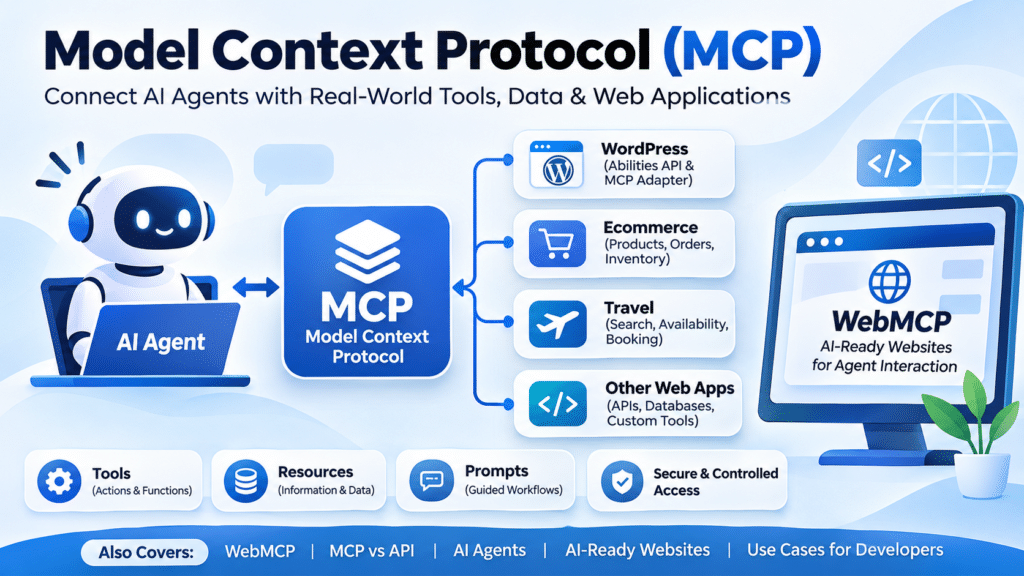
Blog What Is MCP? A Complete Guide to Model Context Protocol, WebMCP & AI Agents for Web Developers in 2026 What Is MCP? A Complete Guide to Model Context Protocol, WebMCP & AI Agents for Web Developers in 2026 Artificial intelligence is changing the way people interact with software. A few years ago, a user would open a website, navigate through menus, fill in a form and click buttons to complete a task. Today, AI assistants and AI agents are increasingly becoming another way to interact with software. But this creates an important technical question: How can an AI application securely discover and use the tools, data and functions provided by different websites and software systems? This is where Model Context Protocol (MCP) comes in. MCP is an open protocol designed to standardise how AI applications connect with external tools, data sources and capabilities. Instead of every AI application requiring a completely different integration for every service, MCP provides a common way for AI systems to discover and interact with capabilities exposed by an MCP server. For web developers, this is becoming an increasingly important area of AI-powered web development, agentic applications and modern software integration. And it is not limited to one country or one type of business. Developers working with WordPress, JavaScript, Python, PHP, ecommerce platforms, SaaS products and custom web applications can all potentially work with MCP. Quick Answer: What Is MCP? MCP stands for Model Context Protocol. In simple terms, MCP is a standardised communication layer that allows an AI application to interact with external tools and information. Think of it this way: AI application → MCP → Tools / Data / Applications The idea is not that MCP magically gives an AI access to everything. Instead, a developer creates or exposes specific capabilities through an MCP server. An AI client can then discover those capabilities and use them according to the permissions and rules defined by the application. The official MCP specification describes MCP as an open protocol for connecting LLM applications with external data sources and tools. The specification is actively evolving, and the July 2026 release introduced a stateless protocol core, capability discovery improvements and additional security and routing changes. Read the MCP specification. MCP Model Context Protocol AI Tool & Context Integration WebMCP Emerging Web Technology 2026 Current Developer Guide What Is MCP? MCP stands for Model Context Protocol. In simple terms, MCP is a standardised communication layer that allows an AI application to interact with external tools and information. Think of it this way: Without MCP: AI application → Custom integration → Application With MCP: AI application → MCP → Tools / Data / Applications The idea is not that MCP magically gives an AI access to everything. Instead, a developer creates or exposes specific capabilities through an MCP server. An AI client can then discover those capabilities and use them according to the permissions and rules defined by the application. A simple example Imagine you have an ecommerce website. Normally, an AI assistant cannot simply decide to access your order database. You might have to build a custom integration that allows the AI application to communicate with your ecommerce system. With MCP, you can expose carefully selected capabilities such as: ✔ Search products ✔ Check stock ✔ Find an order ✔ Retrieve product information ✔ Generate a sales report ✔ Check website information ✔ Create a draft ✔ Run a diagnostic The AI application can discover the tools that are available and decide which tool is appropriate for a particular request. What Is an AI Agent? To understand MCP properly, you also need to understand AI agents. A traditional AI chatbot generally works like this: User → Question → AI → Answer An AI agent can work more like this: User → Goal → AI plans → AI selects tools → Tools perform actions → AI returns result For example, imagine saying: “Find my five best-selling products from last month and prepare a summary.” An AI agent could potentially: 1. Access an approved sales tool. 2. Retrieve sales data. 3. Analyse the information. 4. Identify the five highest-selling products. 5. Generate a summary. 6. Return the result. The important point is that the AI is not merely generating text. It is interacting with software tools. MCP provides one standardised way for those tools and AI applications to communicate. MCP vs AI vs AI Agents These terms are often confused. Artificial Intelligence AI is the broader field of systems capable of performing tasks that normally require human intelligence. Large Language Model An LLM is a model capable of understanding and generating language. AI Application An AI application uses models to provide a user-facing experience. AI Agent An AI agent can use tools, information and actions to accomplish a goal. MCP MCP is a protocol that can standardise how AI applications discover and interact with external capabilities. Easy Way to Remember AI is the intelligence. The AI agent is the worker. Tools are the capabilities. MCP is one of the communication standards connecting the agent with those capabilities. How Does MCP Work? At a high level, an MCP architecture contains an MCP host, an MCP client and an MCP server. The terminology can initially sound complicated, so let’s simplify it. 1. MCP Host The host is the AI application or environment in which the interaction happens. For example, an AI-powered application may act as the host. The host manages the overall AI experience and may create MCP client connections. 2. MCP Client The MCP client handles communication between the AI application and a particular MCP server. It acts as the connection layer. 3. MCP Server The MCP server exposes capabilities that an AI application can use. Those capabilities can include tools, resources and prompts. User ↓ AI Application / Host ↓ MCP Client ↓ MCP Server ↓ Tools / Resources / External Systems The exact implementation can vary, but this basic model is useful for understanding MCP. What Are MCP Tools?
Is WordPress Still Worth It in 2027? What UK Small Businesses Need to Know
Blog Is WordPress Still Worth It in 2027? What UK Small Businesses Need to Know WordPress • Website Development • UK Small Business Guide Is WordPress Still Worth It in 2027? What UK Small Businesses Need to Know The way businesses build and manage websites is changing. Artificial intelligence (AI) website builders can now generate website layouts, write initial content and help users launch websites without extensive technical knowledge. Meanwhile, platforms such as Wix, Squarespace and Shopify continue to offer businesses alternative ways to establish their online presence. With so many options available, an important question arises: Is WordPress still worth it in 2027, or should small businesses consider newer website-building platforms instead? WordPress in 2027 UK Small Businesses AI Website Builders Website Development WordPress SEO Website Costs Quick answer: Is WordPress still worth it in 2027? Yes. WordPress remains a relevant option for many UK small businesses, particularly those that value flexibility, content management, website ownership and the ability to expand their online presence. However, the right platform depends on the business model, required functionality, budget and willingness to manage ongoing maintenance. 1. Is WordPress Still Relevant in 2027? Yes. WordPress remains one of the most widely used website platforms, particularly for businesses that need flexibility, content management and control over their online presence. Its continued relevance is supported by its established ecosystem of developers, themes, plugins and integrations. Recent platform research provides useful context: WordPress powered approximately 31.97% of website homepages in a September 2026 HTTP Archive analysis. A separate analysis of small-business websites found that WordPress accounted for 32.9% of the sampled websites. Research covering more than one million .uk domains found that WordPress appeared on approximately 37% of the analysed UK websites. These figures demonstrate that WordPress continues to have a substantial presence, although its overall market share has experienced some decline. They should be interpreted according to the methodologies and website samples used in each study rather than as a complete count of every website. For UK businesses, the important point is that WordPress is not an outdated platform. It continues to support business websites, blogs, service pages, online publications and e-commerce stores. You can explore the official WordPress platform to learn more about its features and open-source ecosystem. 2. How AI Is Changing Website Development Artificial intelligence is changing how websites are planned, designed and developed. AI-powered website builders can generate layouts, suggest colour combinations, create draft content and help users build basic websites through conversational instructions. This has made website creation more accessible to people without coding experience. However, creating a website and developing an effective business website are two different things. A business website must do more than look attractive. It needs to communicate the company’s value, establish credibility, provide a good user experience and encourage visitors to take action. For example, a UK accounting firm may need appointment booking, enquiry forms, service-specific landing pages and integrations with business software. A professional services company may require a structured blog, lead-generation forms, analytics and advanced SEO configurations. AI can accelerate parts of this process, but businesses still need thoughtful planning, design decisions, technical implementation and ongoing optimisation. Can AI Replace WordPress? AI may reduce the time and effort required to create certain types of websites, particularly simple websites with limited functionality. However, it does not automatically replace the need for a flexible content management system. WordPress offers businesses control over their website structure, content, hosting environment, themes, plugins and integrations. AI tools can also be incorporated into WordPress workflows to support content creation, development and website management. The more useful question is therefore not whether AI will replace WordPress, but how businesses can use AI alongside a suitable website platform. 3. Why UK Small Businesses Still Choose WordPress WordPress offers several advantages that make it suitable for a wide range of small and growing businesses. 3.1 Greater Website Flexibility WordPress can be used to build different types of websites, including: Professional business websites. Service-based company websites. Personal and professional portfolios. Blogs and online publications. Membership websites. Educational websites. Online shops using WooCommerce. Booking and appointment-based websites. This flexibility is particularly useful for businesses that may need additional functionality as they grow. Rather than moving to a completely different platform whenever requirements change, businesses can often extend their existing WordPress website through suitable plugins and custom development. 3.2 Greater Control Over Website Ownership Website ownership is an important consideration when choosing a platform. With a self-hosted WordPress installation, businesses can control their website files, database, hosting account and website content. This gives them greater flexibility when changing hosting providers, appointing another developer or expanding their website. However, ownership also comes with responsibility. Businesses must ensure that their hosting, backups, security and software updates are properly managed. 3.3 WordPress Supports Search Engine Optimisation Search engine visibility is essential for businesses that want to attract potential customers through Google. WordPress provides a flexible foundation for implementing SEO strategies, including the following. For practical guidance, see Google’s SEO Starter Guide and our guide to creating a WordPress website step by step. Custom page titles and meta descriptions. SEO-friendly URL structures. XML sitemaps. Internal linking. Image optimisation and alternative text. Schema markup through suitable tools. Blog and content management. Redirect management. Integration with Google Search Console and Google Analytics. Plugins such as Yoast SEO and Rank Math can make many optimisation tasks easier. However, installing an SEO plugin does not guarantee higher Google rankings. Search performance also depends on content quality, technical health, competition, backlinks, relevance and user experience. 3.4 Scalable Website Development A small business may initially need only a homepage, an about page, a few service pages and a contact form. As the business grows, it may require: Additional service pages. A regularly updated blog. Multiple enquiry forms. Customer testimonials and case studies. Online booking functionality. Membership features. E-commerce integration. CRM and marketing automation. WordPress can accommodate many of these requirements, although complex functionality may require specialist development and additional investment. 3.5 A Large Ecosystem
Google AI Is Changing Search in 2026 — Is Your UK Business Ready?
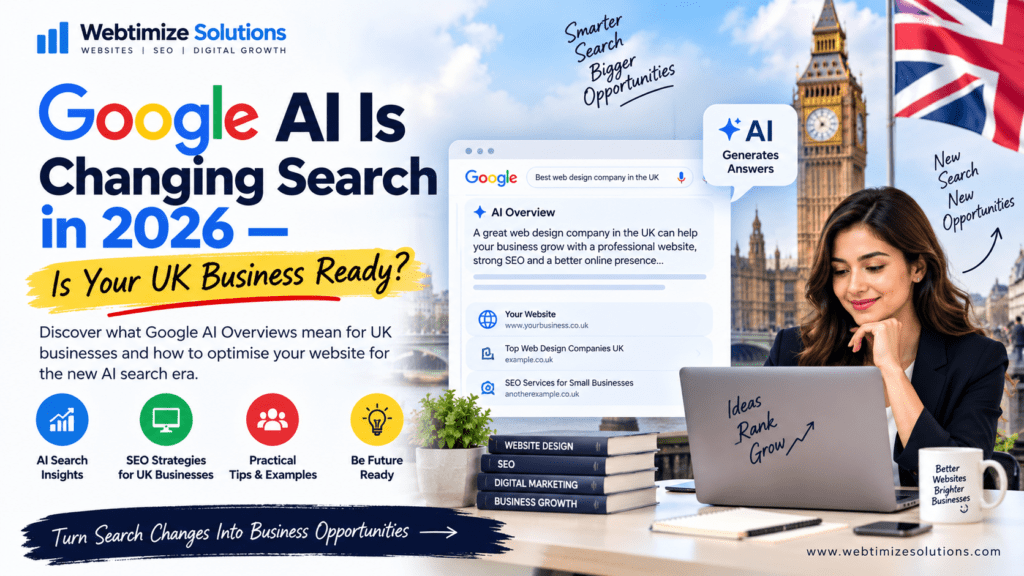
Blog Google AI Is Changing Search in 2026 — Is Your UK Business Ready? UK Business Guide Google AI Search • UK • 2026 Guide Google AI Search 2026: Is Your UK Business Ready to Be Found by AI? Google Search is changing fast. AI Overviews and AI Mode are giving users more conversational, multi-step answers — and UK businesses now have to think beyond simply ranking for one keyword. AI Overviews Google AI Mode SEO 2026 UK Businesses AI Search Visibility Quick answer: You do not need a separate “AI SEO trick” to appear in Google’s generative search features. Google says its AI features are built on core Search systems and recommends the same fundamentals: crawlable and indexable pages, useful and unique content, strong technical SEO, good page experience and content created for people. The opportunity is to make those fundamentals much stronger — especially for the specific questions your UK customers actually ask. What Changed in Google Search for UK Businesses in 2026? Search is no longer just a list of blue links. Google has expanded its AI-powered search experience, including AI Overviews and AI Mode, so users can ask longer, more complicated questions and continue with follow-up questions. Google introduced AI Mode in the UK in 2025, giving UK users a more conversational way to explore information and discover relevant web pages. In 2026, this makes it increasingly important for businesses to publish content that answers real questions rather than simply repeating a target keyword. Official Google source Google explains how AI Mode works in the UK and notes that links to useful web content remain an important part of the experience. Read Google’s UK AI Mode announcement → Google AI Overviews vs AI Mode vs Traditional Search Search experience What the user sees What your website should do Traditional Search Organic results, ads and other Search features. Build strong relevance, technical SEO, authority and compelling titles. AI Overviews An AI-generated overview with supporting web links for eligible queries. Publish useful, original information that can clearly support a user’s question. AI Mode A conversational search experience designed for deeper questions and follow-ups. Cover a topic comprehensively and answer related questions naturally. Will SEO Still Matter in 2026? Absolutely. One of the most important points from Google’s own guidance is that SEO remains foundational for its generative AI search features. Google says there are no additional technical requirements specifically for AI Overviews or AI Mode. A page needs to be indexed and eligible to appear in Google Search with a snippet. That means the basics still matter: crawling, indexing, useful content, internal linking, page experience and a technically healthy website. Official Google Search Central guidance AI features and your website → | Google’s generative AI optimisation guide → Why This Matters More for UK Small Businesses A UK customer may no longer search only for “web design company UK”. They may ask a much more specific question: “How much does a professional website cost for a small business in the UK?” Commercial + informational intent “What should a small business website include in 2026?” Research intent “Which is better for a small UK business — WordPress or a custom website?” Comparison intent “How can a small business get more website traffic without Google Ads?” Problem-solving intent These questions are valuable because they sit closer to the customer’s decision-making process. A website that answers them clearly can support both traditional organic visibility and visibility in AI-powered search experiences. What UK Businesses Should Optimise for AI Search 1 Answer the exact customer question Put a clear answer near the beginning of each important section. Then add evidence, examples, comparisons and practical detail. 2 Build topic authority Connect related articles instead of publishing isolated posts. Your web design, SEO, website cost and technical SEO content should support one another. 3 Show real experience Add original observations, screenshots, examples, project experience, author information and genuine business details wherever relevant. 4 Make the page easy to understand Use descriptive headings, short paragraphs, tables, lists, definitions and FAQs. Make the main answer easy for both people and search systems to find. 5 Strengthen technical SEO Keep important pages crawlable, indexable, mobile-friendly and fast. Fix broken links, indexing problems and poor internal navigation. 6 Think beyond one keyword Cover the main topic plus the related questions, comparisons and follow-up problems a real customer is likely to have. The UK Search Questions Your Content Should Cover Instead of creating dozens of thin pages for tiny keyword variations, build fewer, stronger resources that genuinely satisfy the topic. Google’s 2026 guidance specifically warns against creating content primarily to manipulate search or generative AI responses. ✓ What is the best website platform for a UK small business? ✓ How much does website design cost in the UK? ✓ How long does website development take? ✓ What does professional web design include? ✓ How does SEO help a new business website? ✓ How can a small business increase website traffic? ✓ WordPress vs custom website: which is better? ✓ How important is website speed for SEO? How to Build an AI-Search-Friendly UK Website Start with search intent Identify what the visitor is trying to accomplish. Do they want a definition, comparison, price, service, local provider or step-by-step solution? Give the answer early Do not make readers search through five paragraphs before they reach the answer. Lead with a concise explanation, then provide depth. Support the answer with original value Add examples, practical recommendations, comparisons, screenshots, calculations, first-hand observations or other information that improves the page. Connect related pages Use contextual internal links to help visitors move from one useful topic to another. This also strengthens your site’s overall information architecture. Keep the page technically accessible Check indexing, canonical URLs, mobile usability, page speed, HTTPS, XML sitemap, broken links and crawlability. Build a Strong UK SEO + AI Search Topic Cluster Your AI Search article should not work alone. It should sit inside a connected group of useful resources. Here
How Much Does Google Ads Cost in 2026? UK & US Business Guide
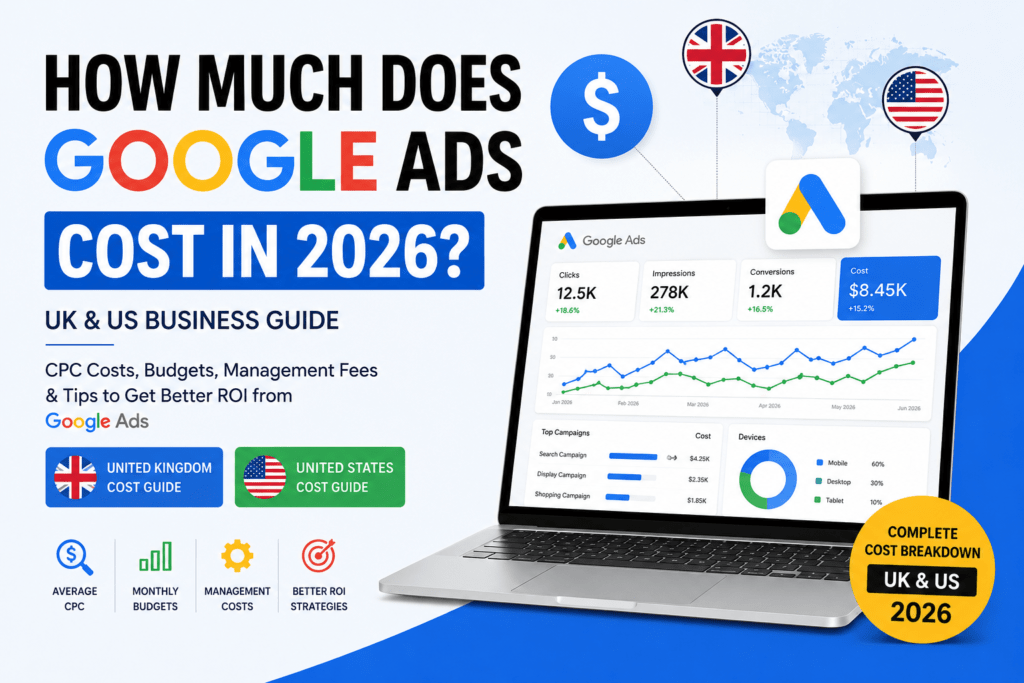
Blog How Much Does Google Ads Cost in 2026? UK & US Business Guide How Much Does Google Ads Cost in 2026? UK & US Business Guide If you are a small business owner in the UK or US, you have probably asked the same question before starting a Google Ads campaign: How much does Google Ads actually cost? The answer is not a fixed price per click. Google Ads operates through an auction, so costs can vary according to the keyword, competition, location, search context, ad quality and campaign strategy. Quick Answer: How Much Does Google Ads Cost? There is no fixed Google Ads price. You choose a budget and Google uses your bids and campaign settings to enter relevant advertising auctions. Your overall Google Ads cost can include advertising spend, campaign management, landing-page development, conversion tracking, creative work and ongoing optimisation. For businesses comparing paid search with organic visibility, our guide to SEO tools for WordPress can also help you understand the SEO side of digital marketing. UK Competitive Search Market US Large Commercial Ad Market CPC Pay-Per-Click Search Model 2026 Current Business Guide How Much Does Google Ads Cost Per Click in the UK? The most common pricing model for Google Search campaigns is cost per click (CPC). You generally pay when someone clicks your advertisement. There is no single UK-wide CPC that applies to every business. A local service, software company, law firm and eCommerce store can all face very different auction conditions. Business / Industry Type Indicative CPC Range Lower-competition services £0.50–£1.50 Many small-business services £1.50–£3.00 Competitive professional services £3.00–£8.00+ Highly competitive legal / finance terms £8.00+ in some cases These figures are indicative rather than guaranteed prices. Actual CPC can change by keyword, location, competition and auction context. What Is the Average Google Ads CPC in the UK in 2026? Average CPC figures can be useful as a starting point, but they can also be misleading. Industry, keyword intent and competition are usually much more important than a single overall average. The Better Question to Ask Instead of asking only: “What is the average Google Ads CPC?” Ask: “What does Google Ads cost for my specific business, keyword and target location?” How Much Does Google Ads Cost in the US? The US is one of the world’s most competitive digital advertising markets. CPC can vary significantly depending on the industry, keyword, location and commercial value of the customer. Commercial searches in sectors such as legal services, insurance, finance, software and professional services can be particularly competitive. Target Clicks × Expected CPC = Estimated Advertising Spend Example Campaign Estimated Spend 500 clicks × $3 CPC $1,500 500 clicks × $7 CPC $3,500 1,000 clicks × $5 CPC $5,000 These are examples rather than guaranteed costs. Actual CPC depends on the live advertising auction and campaign performance. How Much Should a Small Business Spend on Google Ads? Many businesses choose a random monthly budget without calculating how many clicks, leads and customers they actually need. A better approach is to work backwards from customer value and conversion performance. Build Your Budget Around Business Value Customer value → conversion rate → cost per lead → CPC → required traffic For example, if a UK business sells a service worth £2,000 and can acquire a customer for £300 through Google Ads, the campaign may be commercially attractive. If acquiring the same customer costs £1,500, the business needs to review its conversion rate, margins, targeting and landing-page performance before simply increasing the budget. What Does £500 Get You on Google Ads? Imagine your average CPC is £2. A £500 advertising budget could theoretically generate: £500 ÷ £2 = 250 clicks But 250 clicks do not mean 250 customers. 250 clicks × 5% conversion rate = 12.5 leads 12.5 leads × 20% close rate = 2.5 customers Important A cheaper click is not necessarily better. A £1 click that produces no customers can be more expensive than a £5 click that produces a valuable client. Google Ads Cost vs Cost Per Lead For service businesses, cost per lead (CPL) can be more useful than looking at CPC alone. Metric Campaign A Campaign B CPC £1.50 £3.00 Clicks 500 300 Leads 5 30 Total Cost £750 £900 Cost Per Lead £150 £30 Campaign B has the higher CPC but produces dramatically cheaper leads. This is why businesses should optimise around qualified leads and customers, not simply cheap clicks. What Determines Google Ads CPC? 1. Keyword Competition The more advertisers competing for a keyword, the more competitive the auction can become. 2. Customer Value Businesses may be willing to compete more strongly for searches that can generate high-value customers. 3. Ad Quality Google evaluates factors including expected CTR, ad relevance and landing-page experience when assessing ad quality. 4. Location A campaign targeting London can behave differently from one targeting a smaller UK location. US campaigns can also vary by city and state. 5. Search Intent Commercial searches often have stronger purchase intent than broad informational searches. 6. Landing Page Experience A slow, confusing or irrelevant landing page can reduce the effectiveness of your advertising spend. Google’s official guidance explains that Quality Score is a diagnostic tool based on expected CTR, ad relevance and landing-page experience. Google also notes that higher ad quality can contribute to better performance and lower CPC. Read Google’s Quality Score guidance . Google Ads Management Fees in the UK Your advertising budget is not necessarily the same as your total Google Ads cost. If you hire an agency or freelancer, you may also pay a management fee. Cost Example Google Ads Spend £2,000 / month Management Fee £500 / month Total Marketing Cost £2,500 / month Before hiring a provider, ask whether the quoted fee includes: ✔ Google advertising spend ✔ Campaign management ✔ Conversion tracking ✔ Landing-page optimisation ✔ Reporting ✔ Keyword research ✔ Ad copy ✔ Campaign optimisation Google Ads vs SEO: Which Is Better? For many businesses, the best strategy is not choosing between
Apple’s Weak Forecast Shakes Wall Street: Why the Tech Giant Could Lose Nearly $500 Billion in Market Value

Tech News Apple’s Weak Forecast Shakes Wall Street: Why the Tech Giant Could Lose Nearly $500 Billion in Market Value Sunday, August 2, 2026 3:56 pm| Google Gemini AI update | Tech Analysis | Apple’s Weak Forecast Shakes Wall Street: Why the Tech Giant Could Lose Nearly $500 Billion in Market Value Apple’s latest financial forecast has surprised investors worldwide despite the company reporting strong quarterly earnings. The technology giant exceeded analysts’ expectations for revenue and iPhone sales, yet its guidance for the upcoming quarter disappointed Wall Street, sending Apple’s shares sharply lower. According to recent reports, Apple’s stock dropped nearly 10% after the company projected slower-than-expected revenue growth for the next quarter. If the decline continues, Apple could temporarily lose close to $500 billion in market value, making it one of the biggest single-day value declines in the company’s history. The weaker outlook has raised fresh questions about Apple’s supply chain, AI strategy, and future growth prospects. According to Reuters, investors reacted negatively after Apple forecast revenue growth of approximately 9–11% for the current quarter, which fell below Wall Street expectations. The company also highlighted ongoing supply constraints linked to the growing demand for AI data-center components. Why Did Apple’s Stock Fall? Although Apple delivered better-than-expected quarterly earnings, investors focus not only on current performance but also on future guidance. The company’s forecast suggested that growth during the upcoming quarter may be slower than analysts had anticipated. Financial markets generally reward companies that consistently exceed expectations. When a company with Apple’s size and influence projects slower growth, investors often respond quickly by selling shares, leading to significant market volatility. Apple Still Reported Strong Financial Results Despite the negative market reaction, Apple’s latest earnings report contained several positive highlights. Revenue exceeded analyst expectations. iPhone sales remained strong across key global markets. Mac revenue continued to improve. The company maintained healthy profit margins. Apple’s ecosystem continues to generate billions in recurring revenue. These results indicate that customer demand for Apple products remains healthy. However, investors were more concerned about what lies ahead than what the company achieved during the previous quarter. Supply Chain Challenges Continue One of the biggest concerns highlighted during Apple’s earnings announcement was the availability of critical hardware components. As artificial intelligence infrastructure expands globally, demand for advanced chips and memory components has increased significantly. This growing competition for high-end semiconductor components is making it more difficult for companies like Apple to secure sufficient supply for future devices. Management acknowledged that these supply limitations could impact production during upcoming quarters. How AI Is Affecting Apple’s Business The rapid expansion of artificial intelligence has changed the priorities of the global semiconductor industry. Many chip manufacturers are allocating greater production capacity to AI servers and data centers, creating additional pressure on the supply chain for consumer electronics companies. While Apple continues investing heavily in its own AI technologies and Apple Intelligence platform, investors are watching closely to see how the company competes with rivals that have moved more aggressively into generative AI. Investor Confidence Takes a Hit Although Apple reported impressive quarterly earnings, investors were more concerned about what the company expects over the coming months. The latest forecast suggested that revenue growth may not keep pace with market expectations, causing uncertainty among institutional investors and shareholders. Following the announcement, Apple shares fell sharply in pre-market trading, putting the company on track for one of its biggest single-day market value declines in recent years. Analysts pointed to slower services growth, supply-chain constraints, and rising component costs as key reasons behind the market reaction. According to Reuters, Apple also warned that shortages of advanced components linked to the AI data-centre boom could affect future production. :contentReference[oaicite:0]{index=0} Could Nvidia Overtake Apple Again? Apple has long been one of the world’s most valuable companies, but the rapid rise of artificial intelligence has significantly changed the technology landscape. Companies such as Nvidia and Microsoft have benefited enormously from growing investment in AI infrastructure, cloud computing, and enterprise software. If Apple’s share price remains under pressure while AI-focused companies continue to report strong earnings, market analysts believe Nvidia could strengthen its position among the world’s most valuable technology companies. Investors are increasingly rewarding businesses with strong AI growth stories. :contentReference[oaicite:1]{index=1} What Does This Mean for iPhone Users? For everyday consumers in the UK and around the world, there is no immediate reason to worry. Existing Apple products, software updates, and customer support services remain unchanged. However, supply-chain challenges could affect the availability of future iPhone models, MacBooks, and other Apple devices if component shortages continue. Some analysts also believe that higher manufacturing costs could eventually influence retail pricing. Apple’s AI Strategy Under the Spotlight Artificial intelligence has become one of the biggest drivers of growth across the global technology industry. While competitors are rapidly launching new AI-powered services, investors are closely watching Apple’s long-term AI strategy and the future development of Apple Intelligence. The company continues investing in AI-powered experiences across iPhone, iPad, Mac, and Siri, but many investors are looking for stronger evidence that Apple can compete with companies leading today’s AI revolution. Learn more about Google’s latest AI innovations in our guide: Google Gemini AI Update 2026 Why UK Investors Are Watching Apple Closely Apple remains one of the most widely held technology stocks among UK investors through pension funds, investment platforms, and global index funds. Because of Apple’s size and influence, any significant movement in its share price often impacts broader technology markets. Technology professionals, developers, digital businesses, and investors across the United Kingdom continue monitoring Apple’s financial performance, AI investments, and product roadmap as indicators of future trends within the global technology sector. Expert Opinion Many analysts believe the current market reaction reflects short-term concerns rather than long-term weakness. Apple continues generating billions in revenue, maintains one of the strongest customer ecosystems globally, and invests heavily in research, software, silicon development, and artificial intelligence. Nevertheless, investors will closely watch Apple’s next product launches, AI announcements, and supply-chain improvements before regaining
Best Web Design Company for Small Businesses in the UK (2026 Guide)

Blog Best Web Design Company for Small Businesses in the UK (2026 Guide) A Complete Guide for Businesses How Much Does Google Ads Cost in 2026? UK & US Business Guide If you are a small business owner in the UK or US, you have probably asked the same question before starting a Google Ads campaign: How much does Google Ads actually cost? The answer is not a fixed price per click. Google Ads operates through an auction, so costs can vary according to the keyword, competition, location, search context, ad quality and campaign strategy. Quick Answer: How Much Does Google Ads Cost? There is no fixed Google Ads price. You choose a budget and Google uses your bids and campaign settings to enter relevant advertising auctions. Your overall Google Ads cost can include advertising spend, campaign management, landing-page development, conversion tracking, creative work and ongoing optimisation. For businesses comparing paid search with organic visibility, our guide to SEO tools for WordPress can also help you understand the SEO side of digital marketing. UK Competitive Search Market US Large Commercial Ad Market CPC Pay-Per-Click Search Model 2026 Current Business Guide How Much Does Google Ads Cost Per Click in the UK? The most common pricing model for Google Search campaigns is cost per click (CPC). You generally pay when someone clicks your advertisement. There is no single UK-wide CPC that applies to every business. A local service, software company, law firm and eCommerce store can all face very different auction conditions. Business / Industry Type Indicative CPC Range Lower-competition services £0.50–£1.50 Many small-business services £1.50–£3.00 Competitive professional services £3.00–£8.00+ Highly competitive legal / finance terms £8.00+ in some cases These figures are indicative rather than guaranteed prices. Actual CPC can change by keyword, location, competition and auction context. What Is the Average Google Ads CPC in the UK in 2026? Average CPC figures can be useful as a starting point, but they can also be misleading. Industry, keyword intent and competition are usually much more important than a single overall average. The Better Question to Ask Instead of asking only: “What is the average Google Ads CPC?” Ask: “What does Google Ads cost for my specific business, keyword and target location?” How Much Does Google Ads Cost in the US? The US is one of the world’s most competitive digital advertising markets. CPC can vary significantly depending on the industry, keyword, location and commercial value of the customer. Commercial searches in sectors such as legal services, insurance, finance, software and professional services can be particularly competitive. Target Clicks × Expected CPC = Estimated Advertising Spend Example Campaign Estimated Spend 500 clicks × $3 CPC $1,500 500 clicks × $7 CPC $3,500 1,000 clicks × $5 CPC $5,000 These are examples rather than guaranteed costs. Actual CPC depends on the live advertising auction and campaign performance. How Much Should a Small Business Spend on Google Ads? Many businesses choose a random monthly budget without calculating how many clicks, leads and customers they actually need. A better approach is to work backwards from customer value and conversion performance. Build Your Budget Around Business Value Customer value → conversion rate → cost per lead → CPC → required traffic For example, if a UK business sells a service worth £2,000 and can acquire a customer for £300 through Google Ads, the campaign may be commercially attractive. If acquiring the same customer costs £1,500, the business needs to review its conversion rate, margins, targeting and landing-page performance before simply increasing the budget. What Does £500 Get You on Google Ads? Imagine your average CPC is £2. A £500 advertising budget could theoretically generate: £500 ÷ £2 = 250 clicks But 250 clicks do not mean 250 customers. 250 clicks × 5% conversion rate = 12.5 leads 12.5 leads × 20% close rate = 2.5 customers Important A cheaper click is not necessarily better. A £1 click that produces no customers can be more expensive than a £5 click that produces a valuable client. Google Ads Cost vs Cost Per Lead For service businesses, cost per lead (CPL) can be more useful than looking at CPC alone. Metric Campaign A Campaign B CPC £1.50 £3.00 Clicks 500 300 Leads 5 30 Total Cost £750 £900 Cost Per Lead £150 £30 Campaign B has the higher CPC but produces dramatically cheaper leads. This is why businesses should optimise around qualified leads and customers, not simply cheap clicks. What Determines Google Ads CPC? 1. Keyword Competition The more advertisers competing for a keyword, the more competitive the auction can become. 2. Customer Value Businesses may be willing to compete more strongly for searches that can generate high-value customers. 3. Ad Quality Google evaluates factors including expected CTR, ad relevance and landing-page experience when assessing ad quality. 4. Location A campaign targeting London can behave differently from one targeting a smaller UK location. US campaigns can also vary by city and state. 5. Search Intent Commercial searches often have stronger purchase intent than broad informational searches. 6. Landing Page Experience A slow, confusing or irrelevant landing page can reduce the effectiveness of your advertising spend. Google’s official guidance explains that Quality Score is a diagnostic tool based on expected CTR, ad relevance and landing-page experience. Google also notes that higher ad quality can contribute to better performance and lower CPC. Read Google’s Quality Score guidance . Google Ads Management Fees in the UK Your advertising budget is not necessarily the same as your total Google Ads cost. If you hire an agency or freelancer, you may also pay a management fee. Cost Example Google Ads Spend £2,000 / month Management Fee £500 / month Total Marketing Cost £2,500 / month Before hiring a provider, ask whether the quoted fee includes: ✔ Google advertising spend ✔ Campaign management ✔ Conversion tracking ✔ Landing-page optimisation ✔ Reporting ✔ Keyword research ✔ Ad copy ✔ Campaign optimisation Google Ads vs SEO: Which Is Better? For many businesses, the best strategy
10 Reasons Every Small Business Needs a Professional Website in 2026 & Beyond

Blog 10 Reasons Every Small Business Needs a Professional Website in 2026 & Beyond A Complete Guide for Businesses 10 Reasons Every Small Business Needs a Professional Website in 2026 & Beyond Running a small business in 2026 is more competitive than ever. Customers search online before buying almost anything, whether they need a local service, a restaurant, a healthcare provider, or an online store. If your business doesn’t have a professional website, you’re likely losing valuable customers to competitors who do. Many business owners still believe that having a Facebook or Instagram page is enough. While social media helps increase brand awareness, it doesn’t replace a business website. Your website is the only digital asset that you completely own and control. A modern small business website helps build trust, generate leads, improve search engine rankings, and increase sales. Whether you’re a startup, local business, freelancer, or growing company, investing in professional website design is one of the smartest decisions you can make. Why Every Small Business Needs a Professional Website Today’s customers expect every legitimate business to have a website. Before making a purchase or contacting a company, most people search Google to learn more about the business. If they can’t find your website, they may question your credibility and choose another company instead. A professionally designed website gives customers confidence. It showcases your services, highlights customer reviews, answers common questions, and makes it easy for visitors to contact you. More importantly, a website works for your business 24 hours a day, helping you attract potential customers even when your office is closed. 1. Build Trust and Credibility The first impression matters. A professionally designed website instantly makes your business look more trustworthy. Customers often compare multiple businesses before making a decision. A clean, modern, and responsive website creates confidence and encourages visitors to choose your business. Your website should include: Business information Services you offer Customer testimonials Contact details About Us page Portfolio or previous work Adding SSL security, professional branding, and high-quality content further improves customer trust. 2. Improve Your Online Visibility Without a website, your business has limited visibility on Google Search. An SEO-friendly website helps your business appear when customers search for products or services related to your industry. For example, if someone searches for “website design company” or “professional website development services”, businesses with optimized websites have a much better chance of appearing in search results. By combining responsive website design with SEO for small businesses, you can increase organic traffic without relying only on paid advertisements. 3. Generate More Leads and Sales A business website isn’t just about sharing information—it’s one of the most effective lead generation tools available. With strategically placed contact forms, call-to-action buttons, WhatsApp integration, and enquiry forms, your website can convert visitors into paying customers. Unlike social media platforms, where algorithms constantly change, your website gives you complete control over how potential customers interact with your business. A professionally developed website also allows you to track visitor behaviour using Google Analytics, helping you improve conversions over time. 4. Reach Customers 24/7 Unlike a physical store, your business website never closes. It works for your business 24 hours a day, 7 days a week, allowing potential customers to learn about your products or services whenever it’s convenient for them. Whether someone visits your website early in the morning or late at night, they can explore your services, read customer reviews, submit an enquiry, or request a quote without waiting for business hours. This means you never miss an opportunity to generate leads. A professionally designed website also provides important information such as business hours, pricing, FAQs, contact details, and service areas, reducing the number of repetitive customer enquiries. 5. A Website Helps You Rank on Google Most customers begin their buying journey with a Google search. If your business doesn’t have a website, you’re missing valuable opportunities to appear in search results. An SEO-friendly website helps your business rank for keywords that potential customers are already searching for, such as website design services, web development company, or industry-specific local searches. By publishing helpful blog content, optimizing page titles, improving website speed, and using the right keywords naturally, you can attract consistent organic traffic without relying only on paid advertising. Over time, strong SEO can become one of the most cost-effective ways to grow your business online. 6. Your Website Supports Local SEO If you serve customers in a specific city or region, your website plays a vital role in improving your local SEO. People often search for services using phrases like “website design company near me” or “digital marketing agency in London.” When your website is optimized with local keywords, location pages, and accurate business information, Google is more likely to show your business in relevant local search results. For even better visibility, create and optimize your Google Business Profile. Keeping your profile updated with your website, contact details, reviews, and business hours helps customers find and trust your business more easily. 7. A Website Gives You More Control Than Social Media Many small businesses depend entirely on Facebook, Instagram, or other social media platforms. While social media is an excellent marketing tool, it should never replace your website. Social media platforms control their algorithms, meaning your posts may only reach a small percentage of your followers. A website, on the other hand, is completely under your control. Business Website Social Media You own your website and content. Platforms control your visibility. Ranks in Google Search. Limited search visibility. Professional brand image. Mainly used for engagement. Collect enquiries directly. Depends on platform features. Long-term business asset. Algorithms change frequently. The best strategy is to use both together. Social media can drive traffic to your website, while your website converts visitors into customers. Why Responsive Website Design Matters More than half of all website traffic now comes from mobile devices. If your website isn’t mobile-friendly, visitors are likely to leave within seconds. A responsive website design automatically adjusts to different
Best Website Design Company in Varanasi (2026): A Complete Guide for Businesses

Blog Best Website Design Company in Varanasi (2026): A Complete Guide for Businesses Best Website Design Company in Varanasi (2026): A Complete Guide for Businesses Your website isn’t just a digital brochure anymore—it’s your business’s first impression, most reliable salesperson, and one of your strongest marketing assets. Imagine this. A potential customer hears about your business through a friend, social media or Google Search. Within seconds, they visit your website hoping to learn more about your products or services. Now ask yourself one question. Will your website convince them to contact you, or will it send them straight to your competitor? Research consistently shows that visitors form an opinion about a website within just a few seconds. If your website looks outdated, loads slowly or fails to provide the information they’re looking for, they’ll leave—and most never return. That’s why choosing the Best Website Design Company in Varanasi is one of the most important decisions you’ll make for your business. Whether you own a startup, restaurant, hotel, travel agency, coaching institute, hospital, law firm, retail shop, manufacturing business or an eCommerce store, your website should do much more than simply exist online. It should help your business: Build trust instantly Generate qualified leads Rank higher on Google Increase customer enquiries Strengthen your brand Grow your revenue In this comprehensive guide, we’ll explain what makes a great business website, why SEO should be part of every website, and how choosing the right website design company can transform your online presence. Why Every Business Needs a Professional Website in 2026 The way people buy products and services has changed dramatically over the past few years. Today, almost every customer begins their journey online. Before contacting a business, they usually search Google to learn more about the company, compare competitors, read reviews and explore available services. If your business doesn’t have a professional website—or if your existing website looks outdated—you could be losing valuable customers every single day. A professionally designed website helps businesses: Create a powerful first impression Increase customer confidence Reach customers beyond their local market Generate enquiries around the clock Improve search engine visibility Showcase products and services professionally Support long-term digital marketing strategies Your website is often the first interaction customers have with your brand. Make sure it’s a memorable one. The Biggest Mistake Most Businesses Make Many business owners believe that simply launching a website is enough. Unfortunately, that’s one of the biggest misconceptions in digital marketing. A website that doesn’t attract visitors or generate enquiries is no different from opening a beautiful showroom where nobody ever walks in. Thousands of businesses invest in websites every year, yet many fail to see meaningful results because their websites suffer from fundamental problems. Common Website Mistakes Slow loading speed Outdated design Poor mobile responsiveness Weak SEO structure Confusing navigation Low-quality content No clear call-to-action Poor user experience Each of these issues can reduce your Google rankings, increase bounce rates and discourage potential customers from contacting your business. What Makes the Best Website Design Company in Varanasi? Not every web design agency delivers the same level of quality. The best website design companies focus on much more than attractive layouts. They create websites designed to support real business growth. When choosing a website design partner, look for a company that offers: Custom website design Responsive layouts SEO-friendly development Fast loading speed WordPress expertise Secure website architecture Conversion-focused design Scalable development solutions Ongoing technical support Your website should become one of your most valuable business investments—not just another business expense. Why SEO-Friendly Website Design Matters Imagine building the most beautiful office in the city… …but constructing it in a place where nobody can find it. That’s exactly what happens when businesses build websites without Search Engine Optimization (SEO). Even the most visually stunning website will struggle if Google cannot understand its content. SEO-friendly websites help businesses: Rank higher on Google Search Increase organic traffic Generate quality leads Improve online visibility Reduce dependency on paid advertising Create long-term digital growth Professional website development should always include technical SEO from the very beginning rather than adding it later. Features Every Modern Business Website Should Have Modern websites are expected to deliver speed, usability and trust. Here are some essential features every business website should include. Feature Why It Matters Responsive Design Provides a seamless experience across mobile, tablet and desktop devices. Fast Loading Speed Improves user experience and Google rankings. SSL Security Protects customer information and builds trust. SEO-Friendly Structure Helps search engines crawl and index your website efficiently. Clear Navigation Makes it easier for visitors to find important information. Strong Call-to-Action Encourages visitors to contact your business or request a quote. Optimized Images Improves page speed and user engagement. Why Responsive Website Design Is No Longer Optional Today, the majority of internet users browse websites using smartphones. Google also follows a mobile-first indexing approach, meaning your mobile website significantly influences search rankings. If visitors need to zoom, scroll sideways or struggle to use your website on mobile devices, they’ll likely leave within seconds. A responsive website automatically adapts to every screen size, creating a better experience for every visitor. Benefits include: Higher engagement Lower bounce rate Improved SEO performance Better user experience More enquiries and conversions Website Speed Directly Impacts Business Growth People expect websites to load almost instantly. Every additional second increases the likelihood that visitors will leave before viewing your products or services. Fast websites generally experience: Better Google rankings Higher customer satisfaction More page views Better conversion rates Improved brand credibility This is why the best website development companies optimise every website for performance instead of focusing only on design. POPULAR POSTS 20 Jun 2026 Best Website Design Company in Varanasi (2026): A Complete Guide for Businesses 28 May 2026 Why Most Businesses Fail Online Without SEO in 2026 27 May 2026 Website Designing Company in Kanpur (2026) 02 May 2026 How I Earn ₹30,000/Month From Home (Real Method 2026 – Website Design & Freelancing) 28 Apr 2026 How
Why Most Businesses Fail Online Without SEO in 2026
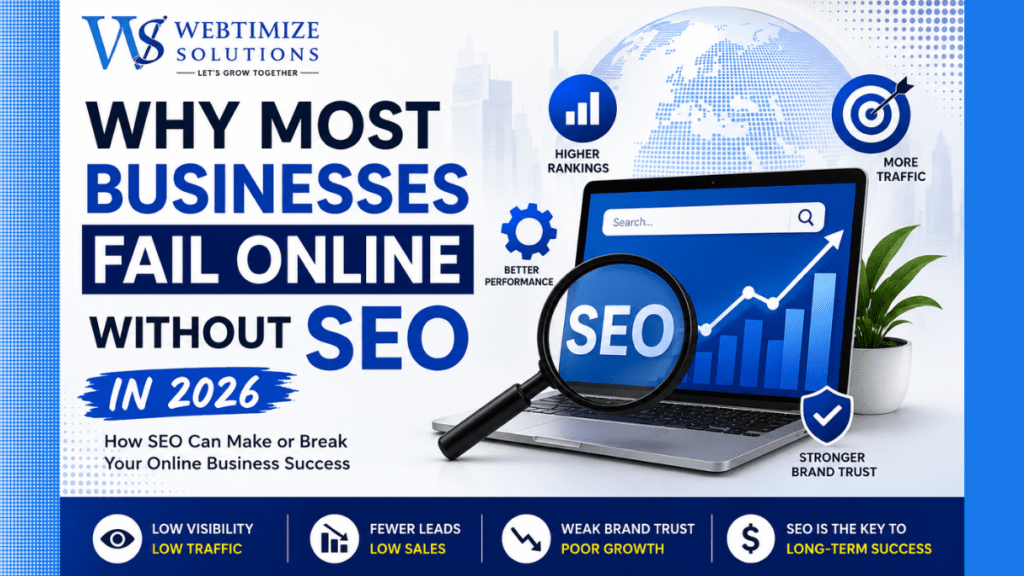
Blog Why Most Businesses Fail Online Without SEO in 2026 Affordable & Professional Website SEO Services Why Most Businesses Fail Online Without SEO in 2026 Millions of businesses are losing customers every single day because their websites are invisible on Google. In 2026, customers search online before trusting any business. Whether someone wants website development services, SEO solutions, ecommerce products, digital marketing agencies or local business services, their journey usually starts with Google Search. But here’s the biggest problem: Many businesses still believe that simply having a website is enough. Unfortunately, that’s no longer true. Without proper SEO optimization, even professionally designed websites struggle to generate traffic, leads and sales. Businesses without SEO often experience: Low Google rankings Poor website traffic Weak online visibility Reduced customer enquiries Lower brand trust Slow business growth Meanwhile, competitors investing in SEO and digital marketing continue attracting customers online every day. Why SEO Matters More Than Ever in 2026 Digital competition is increasing globally. Businesses in countries like the USA, UK, Canada, Australia and India are investing heavily in SEO because online visibility directly affects business growth. Modern customers expect: Fast websites Mobile-friendly design Helpful content Professional branding Trustworthy business information Google now prioritizes websites that provide strong user experiences and useful content. Businesses without SEO often struggle to appear on the first page of search results. What Happens When Businesses Ignore SEO? Problem Business Impact Low Google Rankings Reduced Online Visibility Slow Website Speed Higher Bounce Rates Poor Mobile Optimization Lost Mobile Traffic Weak Content Strategy Lower Engagement No SEO Optimization Fewer Customer Enquiries Poor User Experience Reduced Trust & Conversions Businesses investing in SEO-friendly websites generally achieve stronger long-term digital growth. Why Customers Trust Google Rankings Most users trust businesses appearing on the first page of Google more than websites hidden deep in search results. Higher rankings improve: Brand credibility Customer trust Organic traffic Website engagement Lead generation Sales opportunities This is why SEO has become one of the most important digital marketing strategies globally. Signs Your Website Needs SEO Improvement Many businesses don’t realize their website has weak SEO performance until traffic and enquiries start declining. Common signs include: Low impressions in Google Search Console Poor click-through rates Slow loading speed Weak mobile experience Declining website traffic Low engagement time Few organic leads If your website is not attracting visitors consistently, SEO optimization is likely missing. Why Website Speed Is Critical for SEO Website speed directly affects Google rankings, conversions and customer trust. According to Google Search Central , fast-loading websites provide better user experiences and improve SEO performance significantly. Slow websites usually experience: Higher bounce rates Lower search rankings Reduced engagement Weak conversion rates Businesses should optimize: Images Hosting quality Website code Plugins and scripts Mobile responsiveness Why Mobile Optimization Matters Most internet users now browse websites using smartphones. Google also uses mobile-first indexing, meaning mobile website quality directly affects rankings. Mobile-friendly websites improve: User engagement SEO rankings Customer experience Lead generation Conversion rates Businesses ignoring mobile optimization lose significant traffic every day. How Content Marketing Improves SEO Helpful content helps businesses attract targeted traffic organically. Businesses publishing informative blog posts usually perform better on Google over time because content improves: Keyword visibility Topical authority User engagement Brand trust Search rankings Google prioritizes content that genuinely helps users solve problems. Best Types of SEO Content in 2026 Businesses should focus on creating: Informational blog posts Commercial intent articles SEO guides AI and digital marketing content Website optimization guides Problem-solving content Examples of strong SEO topics include: Why Slow Websites Lose Customers How SEO Helps Small Businesses Grow Website Mistakes Killing Google Rankings Best AI Tools for Businesses Why Internal Linking Is Important Internal linking helps Google understand website structure and improves user engagement. Strong internal linking improves: SEO structure Topical authority Website crawlability User navigation Content visibility Businesses should naturally connect related articles and services. Related resources: How SEO Helps Small Businesses Grow Online Best SEO Tools for WordPress in 2026 How to Get Backlinks in 2026 WordPress vs Shopify (2026) Why Businesses Are Investing More in SEO Businesses globally are realizing that paid ads stop generating traffic once budgets end. SEO, however, continues generating long-term organic traffic. Companies investing consistently in SEO often achieve: Better Google rankings Higher website traffic Lower customer acquisition cost Improved online branding Stronger business visibility SEO is now considered one of the most cost-effective digital marketing strategies. Why AI Is Changing SEO & Digital Marketing Artificial Intelligence is rapidly transforming digital marketing globally. Businesses now use AI tools for: Keyword research SEO optimization Content planning Competitor analysis Marketing automation Popular AI-powered SEO tools include ChatGPT, SEMrush, Jasper AI and Surfer SEO. Businesses interested in AI marketing should also read: Best AI Tools for Small Businesses Why Professional Websites Perform Better Poorly designed websites negatively affect rankings, branding and customer trust. Professional websites improve: SEO performance Mobile responsiveness User experience Conversion rates Business credibility Businesses investing in SEO-friendly websites usually achieve better online growth and customer engagement. Businesses interested in website optimization should also check: WordPress Official Website The Future of SEO & Digital Marketing SEO is becoming more AI-driven, user-focused and mobile-oriented every year. Future SEO trends include: AI-powered search experiences Voice search optimization Personalized content strategies Advanced analytics Smarter search algorithms Businesses adapting early to SEO trends often gain strong competitive advantages. Common SEO Mistakes Businesses Make Many businesses fail online because of: Keyword stuffing Duplicate content Weak website speed Poor mobile optimization Low-quality backlinks Thin content strategy SEO requires consistency, optimization and long-term planning. Conclusion Businesses without SEO are struggling more than ever in 2026. Search visibility, website speed, mobile optimization and content quality now directly affect online growth. Modern businesses need: SEO-friendly websites Fast loading speed Quality content Strong branding Mobile optimization Digital marketing strategies to compete successfully online. Businesses investing in SEO today are building stronger long-term digital growth for the future. RECENT POSTS 28 May 2026 Why Most Businesses Fail Online Without SEO in 2026 27 May 2026